Where Do AI SDRs Get Their Data? Sources That Hold Up
Where do AI SDRs get their data? A source-by-source map: cached databases, live fetch, social intent, hiring and funding signals, and why bounces happen.
A team testing one of the popular AI SDR tools posted the numbers: one or two replies per hundred emails, and half the addresses bouncing despite the vendor's verification claims. Their conclusion was not about the model. It was about the data underneath it.
That conclusion keeps repeating across sales forums, and it is the right question to ask.
So, where do AI SDRs get their data? This guide maps every source these tools actually draw from, what each one is good for, where it fails, and why the data layer, not the writing, decides whether the product works.
Key Takeaways#
- Most AI SDR failures are data failures wearing a copywriting costume: bounces, wrong titles, fake relevance.
- Four source types cover the market: cached databases, live fetch, social intent, and event signals.
- Cached sources answer "who exists"; live and signal sources answer "who, right now, and why".
- Verification belongs at send time. A list verified last month is a bounce list with a delay.
Where do AI SDRs get their data?#
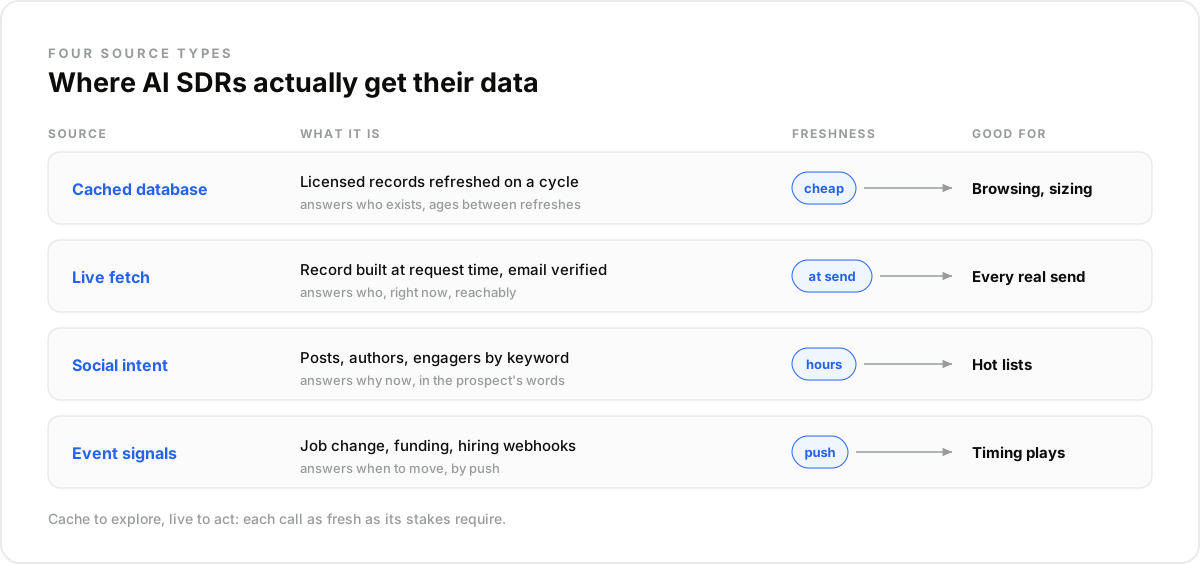
AI SDRs get their data from four kinds of sources: licensed B2B databases cached inside the tool, live lookups against external data APIs, social platforms read for intent, and event feeds like hiring or funding. Which mix a vendor uses explains most of the quality gap between tools.
Vendors rarely advertise the mix. The tell is behavior: a tool whose contacts bounce is reselling a cache; one that cites a prospect's post from yesterday is reading something live. Learning to read those tells is the fastest way to evaluate the category.
Why do AI SDR emails bounce?#
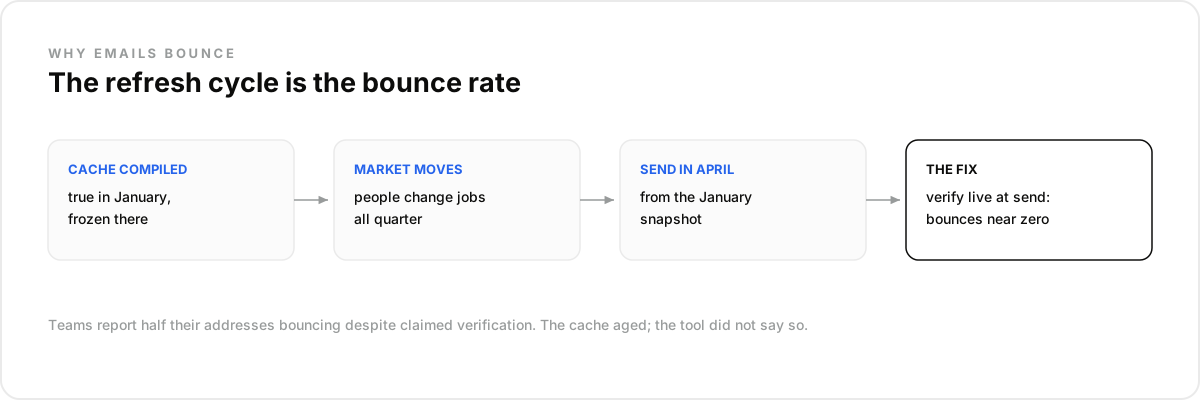
They bounce because the address was true when a database was compiled and false by the time it was used. B2B contact data decays constantly: people change jobs, domains change, inboxes close. A cache refreshed quarterly hands the agent a snapshot of a market that has moved on.
The practitioners comparing tools have started asking vendors one question first: how often does the underlying database refresh? The honest answers range from weekly to quarterly, and the bounce rates track that cycle almost linearly.
The structural fix is not a better cache. It is fetching the record live at the moment of use, and verifying the email in the same pass, which is what a people enrichment API does per request.
What the data layer is NOT#
Three sources get mistaken for an SDR data layer, and each one caps the agent below usefulness. Your CRM is not the market, scraped HTML is not a record, and the model's training data is not current. Every disappointing AI SDR traces to leaning on one of these three.
Not your CRM. A CRM holds your past: people you already met, in states they were in then. Outbound is about the market you have not met. The CRM is the destination for enriched records, never the source.
Not scraped pages. Scraping produces text that needs parsing, cleaning, and guessing. An agent needs typed fields it can filter and chain, not HTML it has to interpret.
Not the model's memory. Training data froze months or years ago. Whatever the model "knows" about a company is a printed directory, not a data source.
Can a cached database power an AI SDR?#
It can power the parts that tolerate age: building a wide first-pass universe, sizing a segment, batch scoring accounts. Caches are cheap per record and fine for browsing. What they cannot safely power is the send, because the send is where a stale field becomes a bounce or an embarrassment.
The working pattern treats the cache as a map, not a contact list. The agent browses cheap records to decide who matters, then upgrades exactly those records through a live fetch before anything is written or sent. Cost stays low; accuracy lands where it pays.
What does a live data layer add?#
A live layer adds the two things a cache cannot promise: the record as it stands today, and a verified channel to reach the person. A live fetch pulls the profile at request time from 20+ aggregated sources, confirms the current employer and title, and returns a work email checked in the same call.
It also adds search depth. A live people search across 800M+ profiles with 40+ typed filters lets the agent express exactly who it needs, current title, tenure, company size, skills, instead of paging through a pre-cut segment someone else defined.
For an SDR agent the division of labor is clean: cache to explore, live to act. Teams that wire both stop debating freshness, because each call is as fresh as its stakes require.
Where does "reach out now" come from?#
Timing data comes from sources that move in hours, not quarters: social posts and event signals. A post asking for a tool recommendation, engagement on a competitor's launch, a burst of sales hires, a funding announcement. These are the sources that turn a contact into a reason.
Social search is the most direct: query posts by keyword across LinkedIn, Twitter, and Reddit, and the authors and engagers come back as profiles the agent can enrich and act on. Event signals arrive as webhooks: a monitor on funding or job changes pushes the trigger to the agent the day it fires.
The build details live in our guide to building a signal-driven AI SDR; the point here is where the data originates, because no cached database contains "why now" at all.
Why the data layer is the product#
Strip any AI SDR to its parts and the writing layer is interchangeable: every tool calls a frontier model. The data layer is where the products actually differ, which sources feed it, how fresh they run, how deeply they can be filtered, and whether verification happens at send time.
The practitioners reviewing these tools keep landing on the same sentence: the tools need better data sources to actually work. That is the category's whole diagnosis in one line. Copy improves at the margin; sources decide the floor and the ceiling.
It is also why builders increasingly skip the packaged SDR and assemble their own: an agent framework, a model, and a data layer like DataForB2B exposing search, enrichment, posts, and signals behind one key. The judgment stays theirs; the data does the heavy lifting.
Test the difference on your own segment. Run a live search and enrichment pass on the free tier from the pricing page.
The mistake most teams make evaluating sources#
The mistake most teams make is comparing coverage numbers instead of decay behavior. Every provider claims hundreds of millions of profiles. Almost none of the comparison pages say what fraction of a segment still holds true this morning, and that fraction is the only number the inbox sees.
In our experience the honest test costs an afternoon: take fifty contacts your team knows personally, run them through the candidate source, and count wrong titles, moved people, and dead emails. What surprised us is how often the biggest brand loses that test to a live fetch.
How Do You Test the Sources Yourself?#
The source map stops being theoretical the moment you run the fifty-contact test from the section above inside Claude. Connect the data layer over MCP and the freshness comparison takes one conversation instead of a procurement cycle.
- Create a free account at app.dataforb2b.ai/signup and grab your API key.
- In Claude, open Settings, then Connectors, and add https://mcp.dataforb2b.ai/mcp. The same server plugs into Cursor, VS Code, ChatGPT, or any MCP-enabled agent.
- Paste the brief: "Here are 30 contacts from our CRM export. Tell me who moved, whose email fails verification, and what changed."
- Turn the working chat into a scheduled routine so it runs monthly, as a data health check without you.
The writing layer is rented; the data layer is the product. See what live search, enrichment, and signals change on your segment via the pricing page.
Frequently asked questions
- Why do AI SDR emails bounce so often?
- Because most tools send from cached databases refreshed on a cycle, and addresses die between refreshes. People change jobs constantly; a quarterly snapshot guarantees a stale slice. Tools that verify each address live at send time push bounce rates toward zero, whatever their coverage number says.
- Is AI replacing SDRs?
- It is replacing the list-building and research hours, not the judgment. The stable pattern practitioners report: agents own signals, sourcing, and enrichment; humans own what prospects actually read. Teams that flipped that division, letting AI write at volume, are the ones burning domains.
- Can your CRM be the data source for an AI SDR?
- No. A CRM describes people you already engaged, as they were when you met them. Outbound targets the market beyond it. The CRM works as the destination where enriched, verified records land, and as a suppression list so the agent never re-contacts an active deal.
- Which source matters most for personalization?
- Social and event data, because relevance is temporal. A prospect's post, their engagement on a competitor's launch, their company's hiring burst: these give the message a reason that is true this week. Firmographic fields personalize the targeting; signals personalize the moment.
- How fresh does AI SDR data need to be?
- Match freshness to the action. Segment sizing tolerates months-old data. Contact details need verification at send time. Timing signals are worthless after days. A tool with one freshness setting for all three is compromising on at least two of them.